The last thing your water touches should be natural.
We're rethinking home water filtration from the ground up — starting with the oldest water-purifying material on Earth.
What is clay filtration?
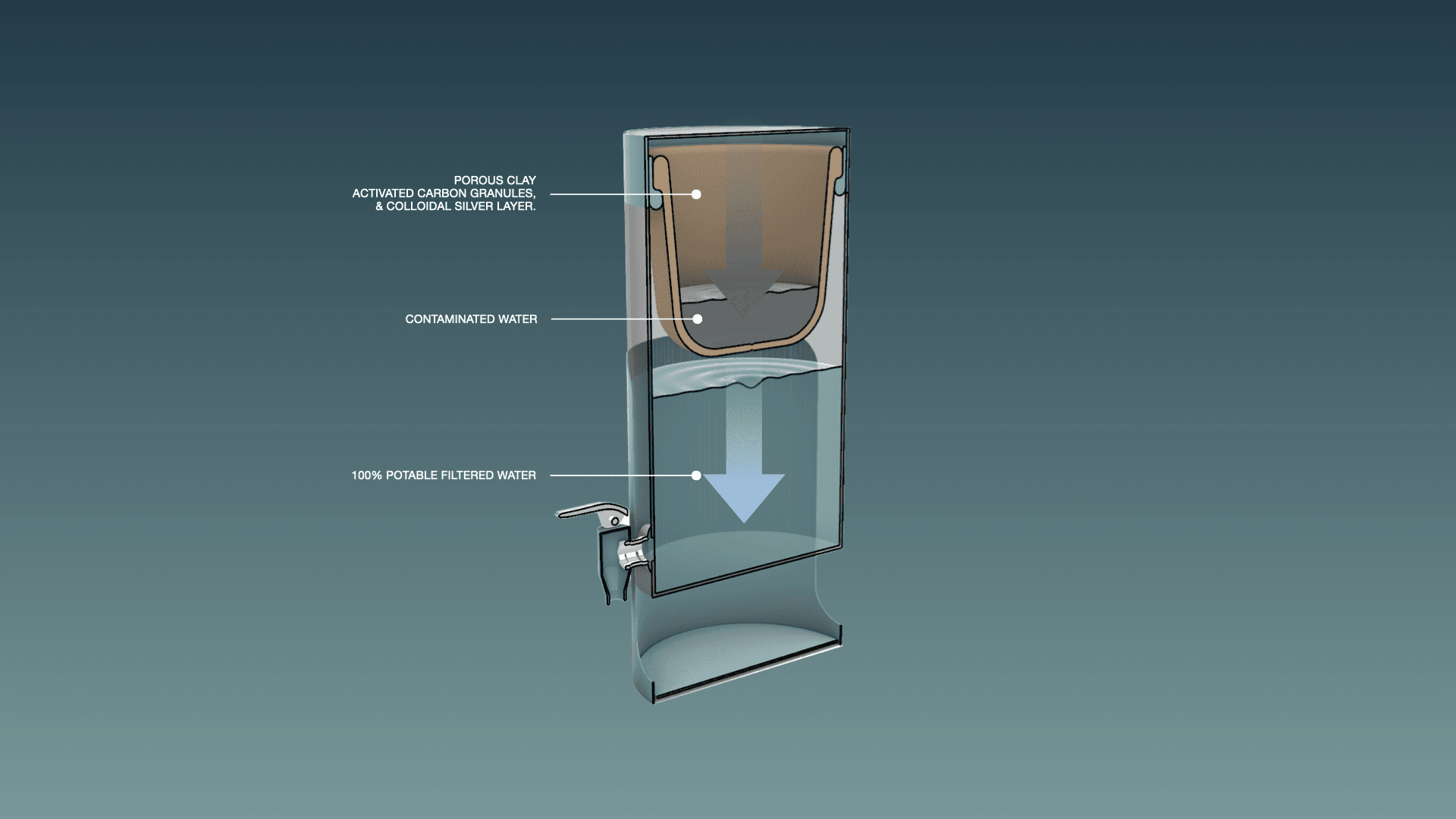
For thousands of years, civilisations have used clay vessels to store and purify water. The principle is simple: water passes through microscopic pores in fired clay, leaving impurities behind.
Clay is a naturally abundant, endlessly recyclable material. It requires no plastics, no synthetic membranes, and no electricity to do its work. Our approach takes this ancient technique and applies modern materials science to understand, optimise, and validate it for today's homes.
A gravity-fed system means water flows through the filter by its own weight — no pumps, no power, no pressure required. You simply pour tap water into the top vessel and clean, filtered water collects below.
The Pore Structure
A clay filter works through its microscopic pore network. During firing, organic materials burn away and mineral particles fuse, creating a labyrinth of tiny channels through which water must travel.
* Conceptual diagram. Actual pore sizes subject to laboratory measurement and characterisation.
Physical filtration
Particles larger than the pore size are mechanically strained out. This includes sediment, rust, and some microorganisms.
Adsorption
Clay minerals carry a natural negative surface charge, attracting and binding positively charged contaminants including certain heavy metals. This property is being characterised in our laboratory programme.
Tortuous path
The winding route through the pore network increases contact time between water and clay surfaces, enhancing the opportunity for contaminants to be trapped or adsorbed.
Our Engineering Process
We follow a deliberate, evidence-led development cycle. Each iteration brings us closer to a filter we can stand behind with data.
Study
We review existing research, analyse traditional clay filter practices, and identify the material characteristics that correlate with filtration performance. We examine clay composition, firing temperature, and pore formation at the microstructural level.
Design
We formulate clay body recipes, design vessel geometries, and prototype filter elements. Each design considers flow rate, mechanical durability, ease of cleaning, and compatibility with a gravity-fed system.
Build
Prototypes are hand-built and fired under controlled conditions. We document every variable: clay source, additive ratios, forming method, drying profile, and kiln schedule — so that results are reproducible.
Validate
Each prototype undergoes flow-rate testing, structural integrity checks, and where applicable, contaminant challenge testing. No performance claim is made until backed by laboratory data and, where appropriate, independent verification.
What we're testing for
We are currently in the research and development phase. The following areas form our testing programme. We will publish results as they become available.
A note on claims
We will not publish filtration performance claims until they have been verified through appropriate laboratory testing. Any statements about contaminant removal on this website or in our materials represent testing targets, not confirmed capabilities. We believe in earning trust through data, not marketing.
Be the first to know
We're building this filter one careful step at a time. Join the waiting list to receive development updates and early access when we launch.
Join the Waiting List